+506 2216 0222
opsaa@iica.int


DID YOU KNOW?
-
43%: Extraordinary Coastal El Niño in summer
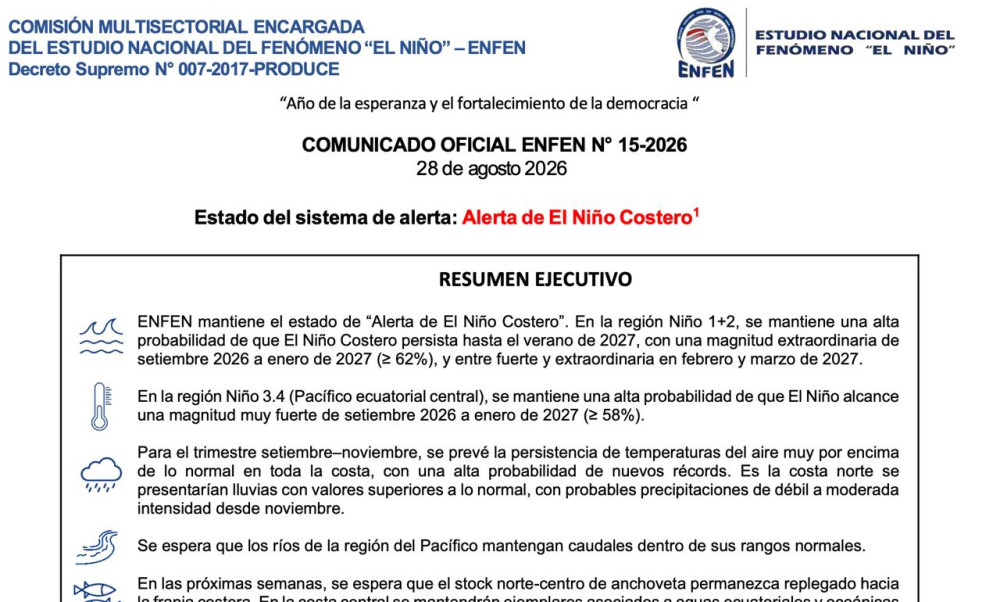
43% is the estimated probability of an extraordinary Coastal El Niño in the Niño 1+2 region during the summer from December 2026 to March 2027. -
62%: Extraordinary Coastal El Niño
62% or higher is the probability that Coastal El Niño will reach extraordinary magnitude in the Niño 1+2 region between September 2026 and January 2027. -
El Niño may pressure two inflation types
2 components of inflation, food and energy, could increase in response to an intense El Niño event in Latin America during 2026.

Peru
A comprehensive look at initiatives and policies that are implemented in Peru for the improvement and modernization of the country's food systems
Resources
(191 records
)

Events
(53 records
)
Evidences
(150 records
)
43%: Extraordinary Coastal El Niño in summer
43% is the estimated probability of an extraordinary Coastal El Niño in the Niño 1+2 region during the summer from December 2026 to March 2027.
62%: Extraordinary Coastal El Niño
62% or higher is the probability that Coastal El Niño will reach extraordinary magnitude in the Niño 1+2 region between September 2026 and January 2027.
El Niño may pressure two inflation types
2 components of inflation, food and energy, could increase in response to an intense El Niño event in Latin America during 2026.
More recent in politics
Investments and Public Expenditure
(380 records
- USD 19,792,256,362.00
)
Peru: Budget Program 0121 - Improving Small Agricultural Producers' Access to Markets
Budget Program 0121 seeks to improve the integration of small and medium-sized agricultural producers into markets and address their limited market access. Created in 2014, it contributes to productivity, competitiveness, sustainability, inclusion, and food security in Peru. MIDAGRI's General Directorate for Agricultural and Agroecological Development is the technical entity responsible for the program.
Regional Action Plan for the 2026-2027 El Niño Event - Ancash
Regional plan of the Regional Government of Ancash aimed at anticipating, reducing and responding to risks and impacts associated with the 2026-2027 El Niño event, particularly intense rainfall and related hazards. The plan is structured around three strategic pillars: risk reduction, preparedness and emergency response. Measures include maintenance of river channels and drainage systems, strengthening of protective infrastructure, training and organization of emergency brigades, acquisition of machinery and equipment, permanent monitoring of vulnerable areas, maintenance of transport connectivity, temporary infrastructure, humanitarian assistance supplies, drinking-water treatment and measures to ensure continuity of essential services.
Comprehensive Disaster Risk Reduction and Preparedness Strategy for the 2026-2027 El Niño Event - 2026 Allocation
National strategy of the Government of Peru to reduce vulnerability, strengthen preparedness and finance preventive and response actions related to disaster risk and the 2026-2027 El Niño event. For fiscal year 2026, the strategy comprises resources under Budget Program 0068 for vulnerability reduction and emergency response, infrastructure interventions associated with El Niño implemented by the National Infrastructure Authority, and multisectoral actions under the 2025-2027 Multisectoral Plan for Intense Rainfall and Associated Hazards. Interventions include river and stream clearing and desilting, riverbank protection, storm drainage, ravine protection, flood defenses, resilient infrastructure, modular bridges, temporary educational infrastructure and other disaster-risk-reduction and preparedness measures.
Policy frameworks
(380 records
)
Peru: Forestry and Wildlife Law (Law No. 29763)
The Forestry and Wildlife Law promotes the conservation, protection, enhancement and sustainable use of Peru's forest and wildlife heritage, integrating its management with the maintenance and improvement of ecosystem services. It establishes the institutional framework led by Serfor and Sinafor and regulates forest planning and zoning, enabling titles, community management, plantations and agroforestry systems, traceability, control, enforcement, incentives, restoration and sanctions.
Peru: Organic Law for the Sustainable Use of Natural Resources (Law No. 26821)
The Organic Law establishes the regime for promoting and regulating the sustainable use of renewable and non-renewable natural resources, including the conditions and mechanisms for granting rights to private parties. It seeks to balance economic growth and investment promotion with the conservation of natural resources, environmental protection and integral human development. It also regulates public participation, ecological and economic zoning, concessions and other access mechanisms, intersectoral coordination, supervision and sustainability conditions.
Supreme Decree No. 012-2026-PRODUCE: Emergency Declaration for the Fisheries and Aquaculture Subsectors in Response to the 2026-2027 El Niño Event
Peru's Supreme Decree No. 012-2026-PRODUCE declares the Fisheries and Aquaculture subsectors under emergency for a period of one hundred and twenty calendar days due to the effects generated by the 2026-2027 El Niño event. The measure allows exceptional, immediate and necessary response and economic-reactivation actions to protect the continuity of fisheries and aquaculture activities and strengthen their value chains. The Decree requires the Ministry of Production to approve, by Ministerial Resolution and within fifteen working days following publication, an Emergency Plan for the Fisheries and Aquaculture Subsectors. The Plan is intended to ensure an efficient State response to potential impacts from El Niño and create conditions for strengthening, responding to and recovering fisheries and aquaculture value chains and their associated actors. Its lines of action include scientific research for the sustainable use of hydrobiological resources, fisheries-management measures for taking advantage of resource opportunities, administrative and sanitary facilitation to ensure continuity of processing activities, payment facilities for fisheries, aquaculture and sanitary administrative fines, promotion of commercialization and market development for hydrobiological products, and access to financing. The Ministry of Production, through the Monitoring and Evaluation Directorate of the General Directorate for Fisheries and Aquaculture Policy and Regulatory Analysis, is responsible for monitoring and evaluating the measures implemented under the Emergency Plan. The Decree also authorizes PRODUCE to adopt complementary measures and modify or expand the Plan's lines of action according to the evolution of the emergency.
Good practices
(21 records
)
Public Services Improvement Project for Sustainable Territorial Development in the Apurímac, Ene and Mantaro Rivers Area of Influence
Project aimed at reducing rural poverty through the social and productive inclusion of families in the VRAEM area. It seeks to increase beneficiaries' human, social, natural, physical, and financial assets. It combines strengthening of territorial governance, development of local economic initiatives, and improved connectivity and community infrastructure.
National Agricultural Innovation System Support Project (PNIA)
The project supports the establishment and consolidation of the National Agricultural Innovation System by strengthening the institutional capacity of the lead public agency, building decentralized innovation networks with public and private stakeholders, and administering competitive grant funds for subprojects in strategic research, adaptive research, agricultural extension, seed enterprise development, and capacity building. It includes a national and international scholarship program for researchers and extension professionals, as well as the design of a monitoring and evaluation system for the agricultural innovation system. Its objective is to create the conditions for member organizations of the national innovation system to improve their effectiveness in developing and delivering improved agricultural technologies to rural producers.
Nitrogen Optimization: Strategies for Addressing the Climate Crisis in Food Production
This project establishes a technical network across five countries (including the Dominican Republic and Panama) to optimize the use of nitrogen fertilizers through the 4R strategy. Its goal is to increase food productivity and reduce $N_{2}O$ emissions by developing common protocols and local emission factors (Tier 2). The results will strengthen national GHG inventories and promote public policies for sustainability and climate resilience in the region.
Dialogue rooms
(6 records
)


Indicators
Partners