+506 2216 0222
opsaa@iica.int


Description
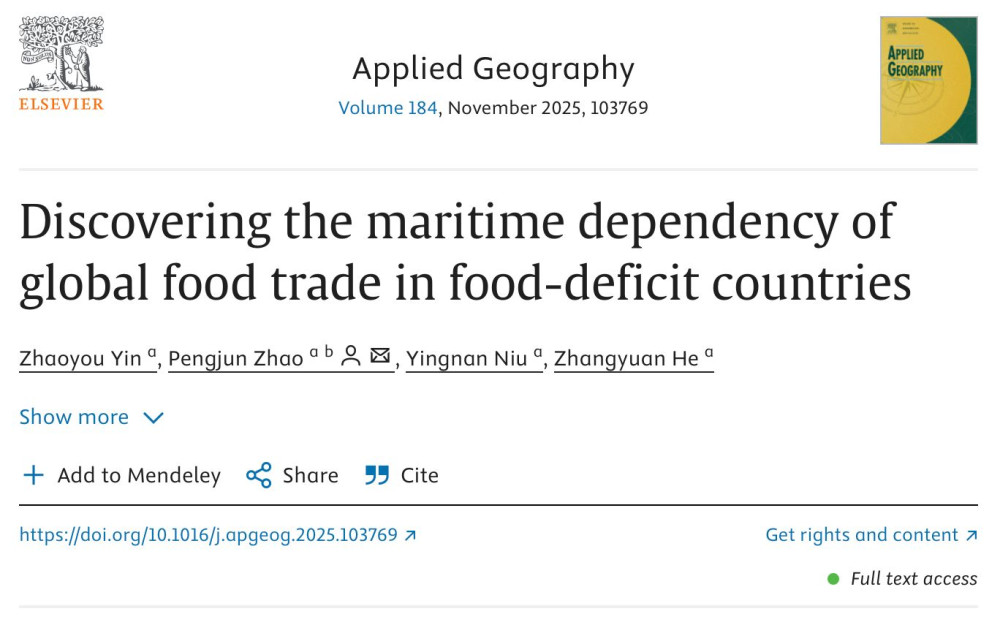
Maritime transport plays a key role in global food trade. However, different countries and regions show a high variety in maritime dependency degree for their food trade. Understanding the variety is important for scholars, politicians and traders. Particularly, it is vital to national food security policy-making. This paper examines the changes of maritime dependency of global food trade in food-deficit countries during the period 2000–2020. We found maritime dependency of global food trade exhibits a hierarchical structure among transport corridors, characterized by a few high-tier main corridors carrying bulk flows and numerous mid- and low-tier corridors serving as regional support routes. The maritime dependency varies significantly between regions. Far East exhibiting highly concentrated routing, West Asia and East Africa relying on redundant corridor systems, and West Africa showing strong dependency on a small number of routes. It also varies by commodity, with soybeans showing the highest concentration and corn featuring more elastic routing. Interestingly, we found although the overall maritime dependency has shifted from concentration to diversification, the overlapping dependency in a few key maritime chokepoints increased. It means the vulnerability of global food shipping is increasing.
Resultados:
Sectors:
Thematic Areas:
Languages:
- English
Beneficiaries:
- Researchers
Countries:
- World (aggregate)
Join to conversation
If you want to join and participate, press "I want to collaborate"; if you dont yet have an account, press "Register".