

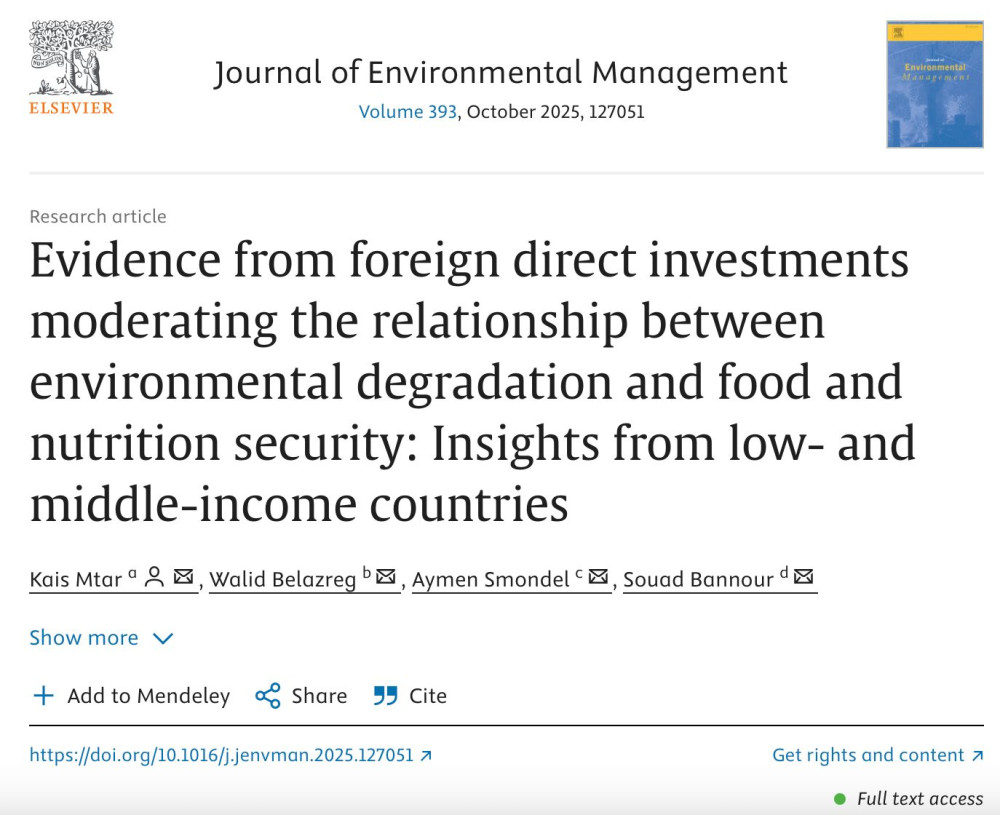
Description
There is a growing interest in understanding the factors that promote food and nutritional security amid environmental damage in low- and middle-income countries. This study presents a new framework to examine the moderating role of foreign direct investment (FDI) - which refers to long-term foreign capital inflows intended for productive activities - in the relationship between environmental degradation and food and nutrition security. For this purpose, the study uses the Two-step System Generalized Method of Moments (System- GMM) estimator on panel data covering 44 low- and middle-income countries over the period 2002 to 2020 - a period chosen to avoid potential biases related to the COVID-19 pandemic. The results show that: (i) CO2 emissions consistently harm food and nutrition security; (ii) FDI positively affects food and nutrition security; and (iii) FDI moderates the negative impact of CO2 emissions, thus reducing the harmful effects of environmental degradation on food security. The main innovation of the study lies in identifying the moderating role of FDI in the relationship between environmental degradation and food security, providing a new perspective for sustainable development policies. The results indicate that well-directed FDI can be an effective tool for public decision-makers and investors focused on ecological transition. The study's findings serve as a practical guide for public policymakers, multinational companies, and investors dedicated to supporting ecological transition and improving global food security.
Resultados:
Sectors:
Thematic Areas:
Languages:
- English
Beneficiaries:
- Researchers
Countries:
- Latin America (aggregate)
ÚNETE A LA CONVERSACIÓN:
Si quieres unirte y participar presiona "Quiero Colaborar"; si aún no tienes tu cuenta presiona "Registrarme".