+506 2216 0222
opsaa@iica.int


Description
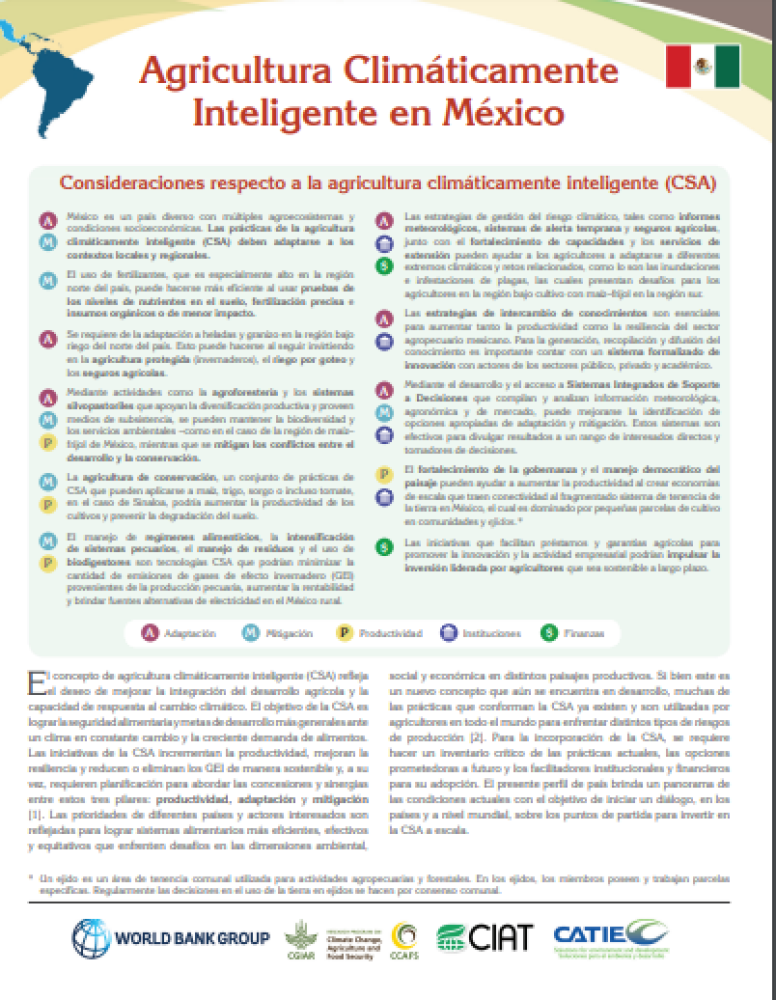
In Mexico, various Climate-Smart Agriculture (CSA) practices are already being implemented. One of the main strategies adopted is agroforestry, which combines agricultural production with trees, helping to conserve biodiversity and improve farmers’ incomes. In addition, silvopastoral systems are used in livestock farming to improve soil quality and capture carbon, while increasing resilience to climate variability. In the north of the country, the use of drip irrigation has increased, especially in crops such as corn and sugar cane, allowing for more efficient use of water. Conservation agriculture practices have also been implemented, such as minimum tillage and crop rotation, which are used to improve soil fertility and reduce erosion. In livestock production, the use of biodigesters has gained ground, allowing the use of organic waste to generate energy and reduce methane emissions. In addition, farmers are adopting water harvesting techniques and the construction of reservoirs to address water scarcity in arid regions.
Institutions:
Authors:
- Argote, Karolina
- Baca, María
- Bouroncle, Claudia
- Cervantes De Blois, Chelsea
- Corner-Dolloff, Caitlin
- Halliday, Andrew
- Imbach, Pablo
- Jarvis, Andy
- Juan Carlos Páez Zamora
- Lizarazo, Miguel
- Louman, Bastian
- Medellín, Claudia
- Nowak, Andreea C.
- Prasodjo, Rauf
- Zavariz-Romero, Beatriz
Resultados:
Sectors:
Thematic Areas:
Instruments:
Languages:
- English
- Español
Beneficiaries:
Countries:
- Mexico
Join to conversation
If you want to join and participate, press "I want to collaborate"; if you dont yet have an account, press "Register".