+506 2216 0222
opsaa@iica.int


Description
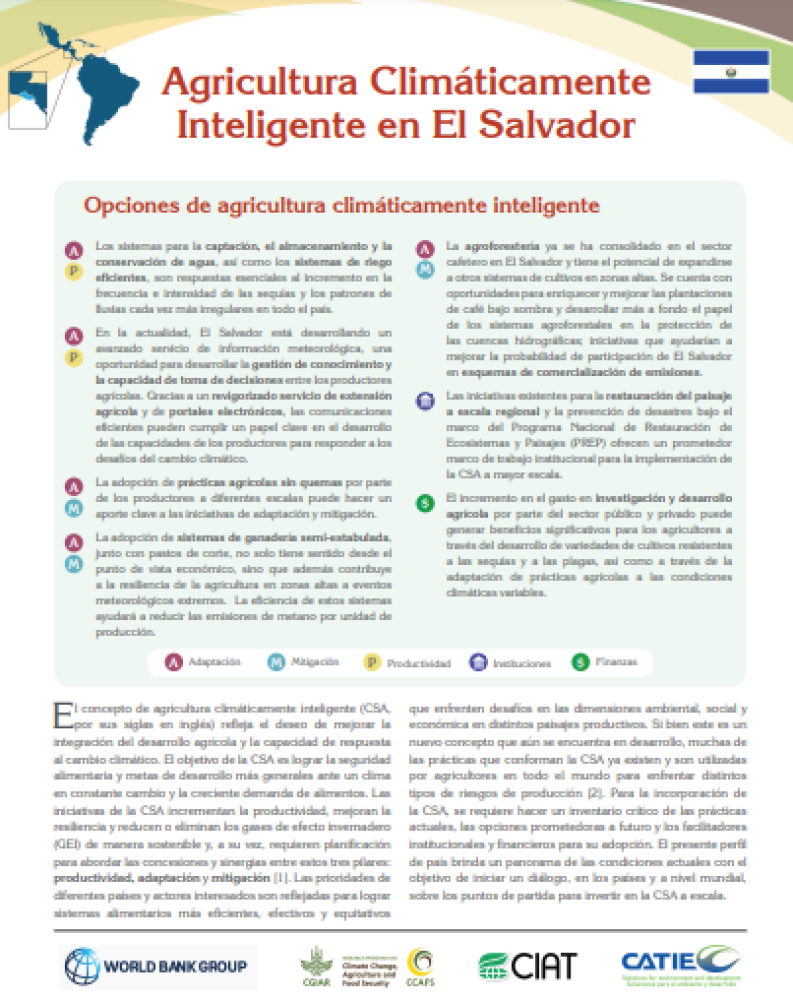
Climate-Smart Agriculture (CSA) in El Salvador focuses on mitigating the effects of climate change and improving agricultural productivity. The country has implemented advanced water capture and storage systems, as well as efficient irrigation, essential to address droughts and irregular rainfall patterns. In addition, it has developed a meteorological service that provides farmers with real-time climate information to improve decision-making and adaptation to climate change. This service is supported by a system of meteorological stations and local observers. At the institutional level, the National Ecosystem and Landscape Restoration Program (PREP) offers a framework to implement these practices on a larger scale. Specific CSA practices being carried out include agroforestry in the coffee sector, the adoption of semi-confined livestock systems, and agricultural production without burning. These practices contribute to resilience to extreme weather events and to the reduction of greenhouse gas emissions. Other measures include changing crop varieties, introducing irrigation systems, and using electronic portals to improve communication between farmers and agricultural extension services.
Institutions:
Authors:
- Argote, Karolina
- Baca, María
- Cervantes De Blois, Chelsea
- Corner-Dolloff, Caitlin
- Halliday, Andrew
- Imbach, Pablo
- Jarvis, Andy
- Juan Carlos Páez Zamora
- Lizarazo, Miguel
- Louman, Bastian
- Medellín, Claudia
- Nowak, Andreea C.
- Prasodjo, Rauf
- Zavariz-Romero, Beatriz
Resultados:
Sectors:
Thematic Areas:
Instruments:
Languages:
- English
- Español
Beneficiaries:
Countries:
- El Salvador
Join to conversation
If you want to join and participate, press "I want to collaborate"; if you dont yet have an account, press "Register".