+506 2216 0222
opsaa@iica.int


Description
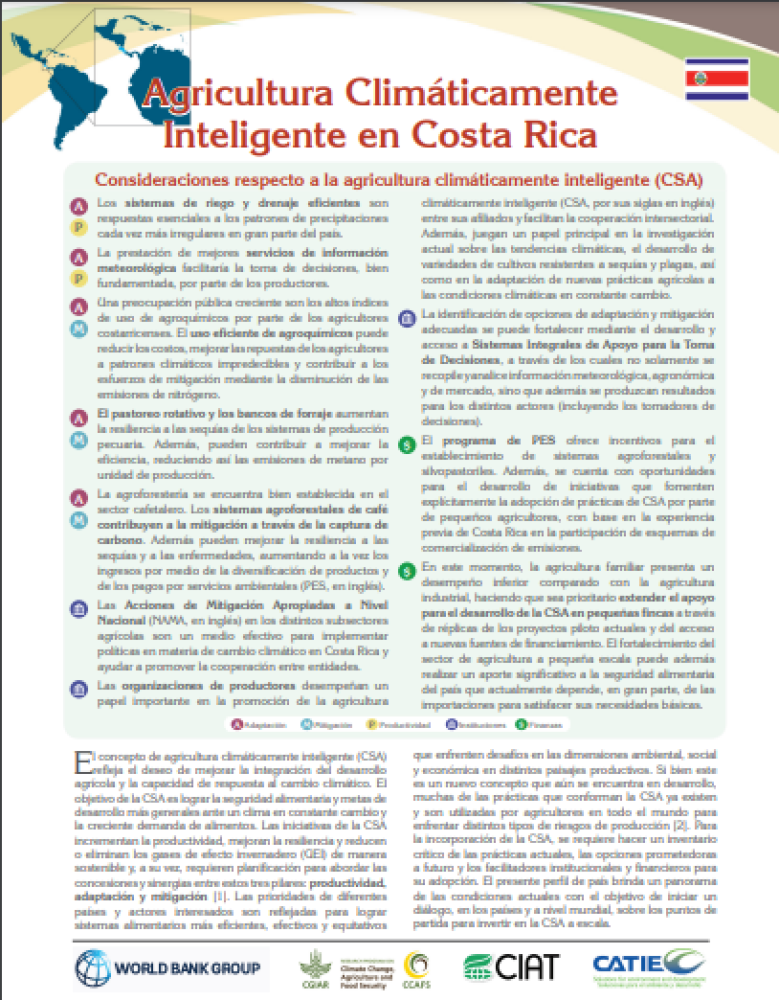
Climate-Smart Agriculture (CSA) in Costa Rica seeks to integrate agricultural development with climate change mitigation and adaptation, promoting food security and sustainable development. The country profile highlights the importance of practices such as efficient use of agrochemicals, improved irrigation and drainage systems, agroforestry in coffee production, and rotational grazing for livestock production. These actions help mitigate greenhouse gas emissions, improve resilience to droughts, and diversify farmers’ incomes through payments for environmental services (PES). Costa Rica already implements key actions such as the Coffee NAMA, which includes reducing nitrogen emissions through the use of slow-release fertilizers, recycling coffee waste to generate energy, and promoting agroforestry systems. In addition, the country has adopted emissions monitoring systems and practices such as water management and agrochemical reduction in sectors such as banana and pineapple.
Institutions:
Authors:
- Argote, Karolina
- Baca, María
- Bouroncle, Claudia
- Bucher, Ana
- Cervantes De Blois, Chelsea
- Corner-Dolloff, Caitlin
- Edmeades, Svetlana
- Halliday, Andrew
- Imbach, Pablo
- Jarvis, Andy
- Lizarazo, Miguel
- Louman, Bastian
- Medellín, Claudia
- Nowak, Andreea C.
- Prasodjo, Rauf
- Zavariz-Romero, Beatriz
Resultados:
Sectors:
Instruments:
- International, public-private partnerships
- Technical assistance to producers
- Carbon capture and storage
- Agricultural extension services
- Incentives or subsidies for the adoption of good sustainable production practices
- Production infrastructure
- Inspection and control
- Policy to Improve Data and Information Access and Management
- PES: Payment for environmental or ecosystem services
Languages:
- English
- Español
Beneficiaries:
Countries:
- Costa Rica
Join to conversation
If you want to join and participate, press "I want to collaborate"; if you dont yet have an account, press "Register".