+506 2216 0222
opsaa@iica.int


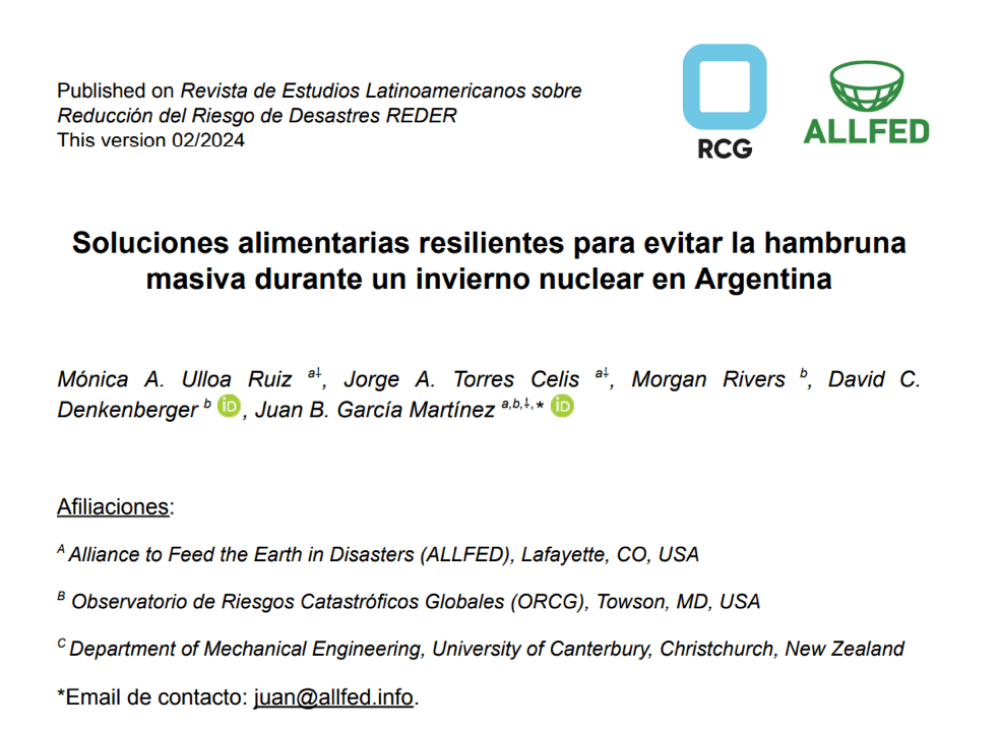
Description
A nuclear war, volcanic eruption, or asteroid or comet impact could reduce the amount of sunlight reaching the Earth's surface, on which the global food system depends. Agricultural yields would fall due to decreased temperatures and precipitation, which is defined as an Abrupt Reduction of Sunlight Scenario (ERALS). Argentina could play a key role should this occur. Interventions that would prevent famine in Argentina and even throughout Latin America are modeled here, including: redirection of food used as feedstock in livestock and biofuel production, rationing, crop relocation, deployment of simple greenhouses and algae cultivation, among others. If appropriate adaptations are not implemented, gross production could fall to 30% of the current level, which would be insufficient for Argentina's population. Fortunately, the results indicate that even in a 150 Tg scenario, adaptations would allow increasing net production from a national famine situation (1500 kcal/day/person) to a production equivalent to 3 to 6 times the amount needed for the Argentine population (7800 - 14000 kcal/day/person).
Institutions:
Authors:
- Jorge Torres Celis
- Juan García
- Monica Ulloa
- David Denkenberger
- Morgan Rivers
Resultados:
Sectors:
Thematic Areas:
Instruments:
Languages:
- Español
Beneficiaries:
- Public institutions
Countries:
- Argentina
Join to conversation
If you want to join and participate, press "I want to collaborate"; if you dont yet have an account, press "Register".