+506 2216 0222
opsaa@iica.int


DID YOU KNOW?
-
Panama Canal: El Niño cut daily transits
24 vessels per day transited the Panama Canal during the 2023–24 El Niño drought, down from the usual 36, with draft restrictions set at 44 feet (Noll, 2026). -
Decline in RIP agriculture in LAC
In 2023, the relative internal productivity of the Agriculture sector in Latin America and the Caribbean was 44 (with total productivity coefficient = 100), showing its lag compared to sectors with higher productivity, according to the sectoral graph... -
Agriculture vs. other sectors IAP
In the sectoral mapping of PAIs, agriculture, forestry, hunting and fishing accounts for 248 PAIs (34.8%), followed by manufacturing (188), tourism (70) and ICT (51); additionally, 32 PAIs in health are identified, according to the report (ECLAC, 202...

Panama
0
Resources
(74 records
)

Events
(14 records
)

Evidences
(61 records
)
Panama Canal: El Niño cut daily transits
24 vessels per day transited the Panama Canal during the 2023–24 El Niño drought, down from the usual 36, with draft restrictions set at 44 feet (Noll, 2026).
Decline in RIP agriculture in LAC
In 2023, the relative internal productivity of the Agriculture sector in Latin America and the Caribbean was 44 (with total productivity coefficient = 100), showing its lag compared to sectors with higher productivity, according to the sectoral graph of the report (ECLAC, 2025).
Agriculture vs. other sectors IAP
In the sectoral mapping of PAIs, agriculture, forestry, hunting and fishing accounts for 248 PAIs (34.8%), followed by manufacturing (188), tourism (70) and ICT (51); additionally, 32 PAIs in health are identified, according to the report (ECLAC, 2025).
More recent in politics
Investments and Public Expenditure
(113 records
- USD 5,064,701,769.00
)
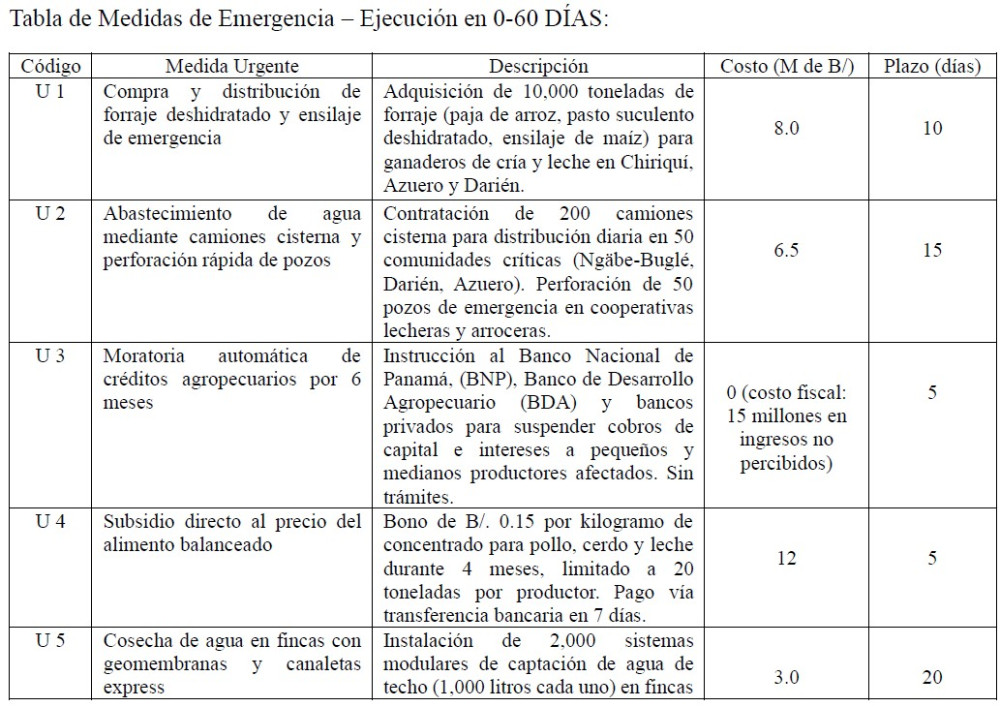
Expansion of agricultural mitigation measures in Panama's Dry Arc under the El Niño climate emergency (2026-2027)
Public funding package of B/. 8.21 million to expand prevention and mitigation measures addressing the effects of El Niño on the agricultural sector in the most vulnerable areas of Panama's Dry Arc, specifically Los Santos, Herrera, Coclé and parts of Veraguas. Measures presented by MIDA prioritize water security and include well inventories and flow measurements, rehabilitation and construction of livestock watering facilities, reservoirs and pumping systems, assessment of small dams, strategic forage reserves, distribution of productive inputs, and strengthened animal and plant health control and pest and disease monitoring.
MIDA acquisition of machinery, veterinary medicines, livestock supplements and spare parts to mitigate El Niño impacts (2026)
Intervention by Panama's Ministry of Agricultural Development (MIDA) to support agricultural producers facing the effects of El Niño through the acquisition of machinery, veterinary medicines, livestock supplements and spare parts. As of September 3, 2026, MIDA reported approximately B/. 1.2 million in executed expenditure. Documented livestock inputs include multivitamins, vitamins, protein-enriched mineral salts and medicines intended to support producers and reduce the effects of drought and heat stress on livestock.
Nitrogen optimization: Strategies to address the climate crisis in food production
Regional technical cooperation project aimed at optimizing nitrogen fertilizer use and reducing nitrous oxide emissions in agricultural systems in Chile, Argentina, Peru, Panama, and the Dominican Republic. The project seeks to generate specific emission factors, evaluate nitrogen sources, rates, and application timing, develop mitigation strategies, maintain yields, strengthen national greenhouse gas inventories, and generate best-practice recommendations for efficient nitrogen use.
Policy frameworks
(166 records
)
Advisory to Shipping No. A-29-2026: Additional Measures to Address Reduced Precipitation in the Canal Watershed
Advisory to Shipping No. A-29-2026 establishes temporary preventive measures in response to reduced rainfall and watershed inflows in the Panama Canal watershed and the projected severity of the 2026-2027 El Niño event. The document reports that cumulative rainfall from May through August 2026 was 34 percent below the historical average and watershed inflows were 44 percent below average. Effective August 21, 2026, for booking dates beginning September 4, it reduces daily availability to nine slots at the Neopanamax Locks and twenty-five slots at the Panamax Locks. Effective September 1, for booking dates beginning September 15, Panamax availability is reduced to twenty-three daily slots. The advisory also postpones the 14.63-meter maximum authorized draft until September 2 and the 14.48-meter adjustment until October 1 at the Neopanamax Locks. The measures seek to maintain service reliability, safeguard water resources for human consumption, and provide timely information for transit planning and supply-chain decisions.
Law 543 of 2026: Mandatory Identification of Origin and Differentiation of Original, Substitute and Imitation Food Products
Law 543 of July 7, 2026 establishes mandatory identification of origin and differentiation of original, substitute and imitation food products in Panama, with the objective of protecting consumers and domestic producers, preventing misleading commercial practices and ensuring clear information about the nature and origin of food products. The Law requires commercial establishments to visibly identify products as domestic or imported, display the product name in Spanish and indicate the country of origin, and clearly warn consumers when products are substitutes or imitations. Substitute and imitation products must carry specific signage and be physically separated by at least one meter from original products. Imported food products must be marketed under the same technical specifications and origin conditions under which they entered the country, and frozen meat products may not be presented in a manner that could cause consumers to confuse them with fresh domestic products. The Consumer Protection and Competition Defense Authority (ACODECO) is responsible for enforcement, with fines of up to fifteen thousand balboas and certain violations classified as food fraud. The Law also requires consumer-awareness and education campaigns, repeals Law 113 of 2019 and will enter into force one year after promulgation.
Executive Decree No. 2 of 2026: Extraordinary Measures for the Importation of Certified Rice Seed
Executive Decree No. 2 of February 4, 2026 establishes extraordinary measures for the importation of certified-category rice seed of varieties formally registered in commercial variety registers in their country of origin. The measure allows natural or legal persons producing rice for human consumption to import certified seed for planting during the 2026-2027 agricultural cycle, with the objective of streamlining import procedures, improving the competitiveness of rice seed, supporting domestic producers and contributing to food security. Importers must register with the National Plant Health Directorate, submit documentation demonstrating the commercial registration of the varieties in the country of origin, provide official quality certificates for the seed lots and submit the results of phytosanitary tests required for importation. They must also sign a notarized agreement committing to use the imported seed exclusively on their own agricultural plots and not to sell, lend, transfer or otherwise commercialize it. The National Plant Health Directorate performs quarantine controls, quality analyses and phytosanitary compliance verification when the seed lots enter Panama.
Good practices
(9 records
)
Strengthening Strategic Capacities for Water Security in Prioritized Watersheds of the SICA Region
The project aims to contribute to water security in prioritized watershed territories of the SICA region by producing technical diagnostic studies, cost-of-inaction/benefit-of-action analyses (BACI), and strategic water investment plans with bankable project profiles per watershed. It operates in 8 watersheds across 8 countries —Belize, Guatemala, Honduras, El Salvador, Nicaragua, Costa Rica, Panama, and the Dominican Republic— incorporating gender, intercultural, and climate risk perspectives
Strategy for Technological Innovation to Improve the Productivity and Competitiveness of Supply Chains in Central America and the Dominican Republic
PRESICA developed a regional agricultural innovation model based on Local Innovation Consortia, which bring together producers, research institutes, universities, NGOs, and the private sector around value chains for corn, beans, cassava, and sweet peppers. The strategy was grounded in producers’ technological needs to drive research, technology validation, technology transfer, and extension services with a territorial focus. The project operated in eight Central American countries and the Dominican Republic, forming 22 local consortia. It contributed to strengthening national and regional agricultural innovation systems as a public good.
Nitrogen Optimization: Strategies for Addressing the Climate Crisis in Food Production
This project establishes a technical network across five countries (including the Dominican Republic and Panama) to optimize the use of nitrogen fertilizers through the 4R strategy. Its goal is to increase food productivity and reduce $N_{2}O$ emissions by developing common protocols and local emission factors (Tier 2). The results will strengthen national GHG inventories and promote public policies for sustainability and climate resilience in the region.
Dialogue rooms
(4 records
)


Partners