+506 2216 0222
opsaa@iica.int


DID YOU KNOW?
-
10 billion people will require more food
10 billion people will need to be fed through technologies that enable more food to be produced at a lower cost. -
US$9 billion for agricultural innovation
US$9 billion was allocated to new research aimed at increasing agricultural yields, compared with US$2.5 billion in 2016. -
75% still do not use AI in farming
75% of producers in the United States still do not use artificial intelligence tools in agriculture, despite their advance and growing importance for agricultural competitiveness.

Digital Transformation
A hemispheric look at public-private interventions for the agri-food digital transformation
Resources
(133 records
)
Events
(47 records
)

Evidences
(47 records
)
10 billion people will require more food
10 billion people will need to be fed through technologies that enable more food to be produced at a lower cost.
US$9 billion for agricultural innovation
US$9 billion was allocated to new research aimed at increasing agricultural yields, compared with US$2.5 billion in 2016.
75% still do not use AI in farming
75% of producers in the United States still do not use artificial intelligence tools in agriculture, despite their advance and growing importance for agricultural competitiveness.
More recent in politics
Investments and Public Expenditure
(124 records
- USD 31,883,977,143.00
)
Climate-Smart Livestock in Ecuador: A Strategic Partnership between FAO and the Private Sector
Pilot project implemented in Cayambe, Pichincha Province, to strengthen the capacities of technicians and family livestock producers in Climate-Smart Livestock. The intervention adapted and validated participatory tools, identified good livestock practices, improved digital data collection and analysis, and estimated greenhouse gas emissions using tools such as ODK and GLEAM-R. It was developed by Ecuadorian public institutions, FAO, GEF, and the company El Ordeño.
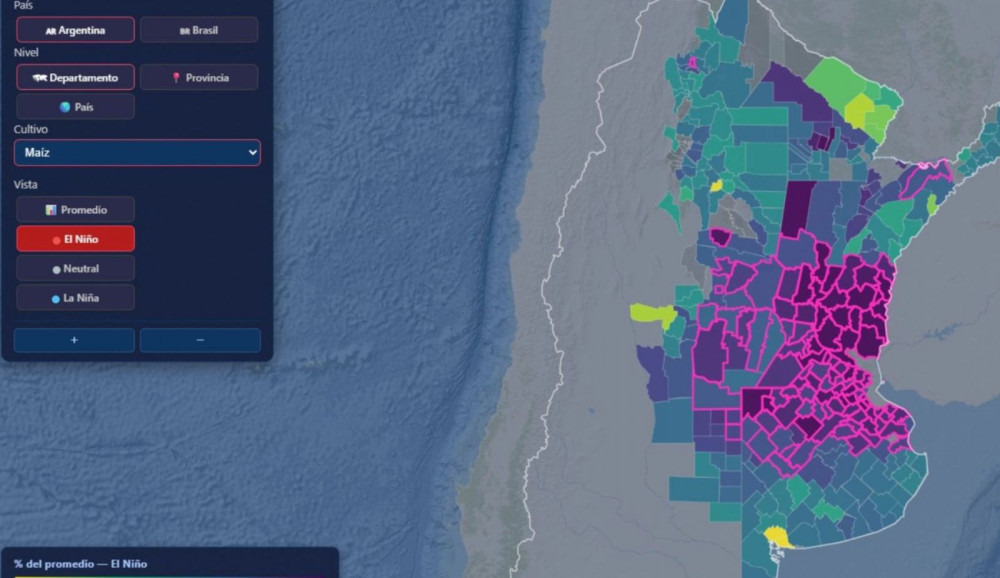
Federal Monitoring and Health Emergency Response System for El Niño
Federal initiative implemented by Argentina's Ministry of Health and the Federal Emergency Agency to strengthen prevention, monitoring and response capacities in anticipation of potential impacts from El Niño and other hydro-meteorological emergencies. The system integrates health and meteorological information using digital tools and georeferenced maps to identify hospitals, health facilities, vulnerable populations, available resources and potentially affected areas. It also includes coordination with provincial governments, epidemiological surveillance, contingency planning and territorial deployment through mobile health patrols, advanced stabilization posts and modular hospitals.
Program for Sustainable and Competitive Agriculture in Costa Rica
National program implemented by Costa Rica's Ministry of Agriculture and Livestock (MAG) to improve the sustainability, competitiveness and economic participation of small and medium agricultural producers. The operation uses a Program-for-Results (PforR) financing approach and has total financing of US$695 million: US$555 million in counterpart financing from the Government of Costa Rica, US$120 million from the International Bank for Reconstruction and Development (IBRD/World Bank), and US$20 million from the International Fund for Agricultural Development (IFAD). The Program includes modernization of public agricultural extension services, a digital producer information platform, agricultural traceability, productive and cold-chain infrastructure, technical assistance, access to financing for adoption of NAMA practices, and payments for environmental services related to carbon sequestration in agricultural soils. The Program will directly benefit 10,500 producers and reach 30,000 producers through direct and indirect benefits, equivalent to approximately 90,000 people when household members are included, with explicit attention to women and youth.
Policy frameworks
(145 records
)
Development National Plan (Mexico) 2025-20230
The National Development Plan (NDP) serves as the roadmap for the objectives and actions of the Government of Mexico in the coming years. These objectives aim to consolidate the country’s transformation under a development model centered on well-being, social justice, and sustainability.
Resolution 50/2026: Management of Agricultural Tariff-Rate Quotas under the MERCOSUR-European Union Interim Trade Agreement
Resolution 50/2026 of Argentina's Secretariat of Agriculture, Livestock and Fisheries approves the general and specific rules governing the national management of agricultural export and import tariff-rate quotas opened under the Interim Trade Agreement between MERCOSUR and the European Union. The regulation establishes eligibility requirements for commercial operators, registration and administration of export quotas, issuance of MERCOSUR Quota Authorization Certificates and Import Licenses, interoperability with customs and single-window systems, compliance with sanitary, phytosanitary, labeling and packaging requirements when applicable, and coordination with regional quota-management systems. Export quota administration is mainly carried out through SIACE and SACME, while import licensing is integrated with VUCEA, ARCA and the Malvina Customs Information System.
Free Trade Agreement between MERCOSUR and the Republic of Singapore
The Free Trade Agreement between MERCOSUR and the Republic of Singapore establishes a comprehensive framework to deepen economic and trade relations between Argentina, Brazil, Paraguay, Uruguay, and Singapore. The agreement includes disciplines on national treatment and market access for goods, immediate and gradual tariff elimination, rules and certification of origin, customs procedures and trade facilitation, sanitary and phytosanitary measures, technical barriers to trade, trade remedies, safeguards, investment, trade in services, electronic commerce, government procurement, competition, intellectual property, geographical indications, transparency, micro, small and medium-sized enterprises, and dispute settlement. Singapore eliminates tariffs on all products exported by MERCOSUR upon entry into force, while MERCOSUR liberalizes 95.8 percent of its tariff lines through immediate commitments and gradual schedules. The agreement seeks to expand exports, increase investment, strengthen competitiveness, facilitate access to inputs and technologies, and improve the predictability of trade relations.
Good practices
(12 records
)
E-KAKASHI: The Agricultural Intelligence Brain
The project seeks to improve the productivity and sustainability of rice cultivation in Colombia through an innovative technological solution that combines Internet of Things, big data, artificial intelligence and cyber-physical systems. This technology, developed by PS Solutions (Softbank Group), transforms agriculture into a science based on data by collecting real-time information from the environment and crops to determine optimal levels of agricultural parameters. The project will benefit 16,000 Colombian rice farmers, especially small producers from areas affected by armed conflicts who face productivity problems due to lack of access to technologies and financial services. Additionally, e-kakashi contributes to solving environmental problems by optimizing water use and reducing methane emissions from rice paddies, which represent approximately 20% of global emissions of this gas. The project has two phases: demonstration of efficacy under real conditions in collaboration with CIAT and commercial expansion in Latin America and the Caribbean, combining non-reimbursable technical cooperation (up to US$500,000) with equity investment (up to US$1,500,000).
Agricultural Policies for Food Security, Competitiveness and Sustainability in Mexico
This technical cooperation aims to strengthen the institutional capacities of the Secretary of Agriculture and Rural Development (SADER) through the development and implementation of strategic tools and specialized instruments that increase the effectiveness of public policies oriented towards sectoral competitiveness and sustainability of the Mexican agricultural and fishing sector. The TC will support studies, methodologies and specialized consultancies that will strengthen the registry and program roster system, the agricultural and rural statistics system, including support in remote sensing methodologies and direct marketing models between small and medium producers. It will also finance the development of a Master Plan for Sustainable Development of Fishing, Aquaculture and Mariculture in the Peninsula and Gulf of California. The project seeks to address the structural challenges of the Mexican agricultural sector related to limited institutional capacities, fragmented information systems and barriers to the inclusion of small and medium producers. The initiative contributes directly to strengthening national food security through more effective and sustainable public policies.
Support for the Development of Coffee Forest Information Systems in El Salvador
IDB technical cooperation aimed at designing a national system that generates and disseminates relevant and timely information for the design, monitoring, and evaluation of competitiveness and sustainability policies for Salvadoran coffee growing. The project seeks to strengthen the coffee sector's information systems by developing a statistical system comprised of a coffee grower registry, a georeferenced coffee census, and complementary surveys that generate dynamic data with national coverage. It includes the design of mechanisms for capturing and analyzing information from national and international markets, as well as traceability systems using blockchain methodology. The project addresses the problem of the lack of specialized information that limits the design and implementation of effective policies for a sector that represents 22% of the country's forests and has historically been a national economic driver. The initiative supports the execution of loan ES-L1135 "Strengthening the Climate Resilience of Coffee Forests in El Salvador."
Dialogue rooms
(1 records
)